For years, the ideal product development process was:
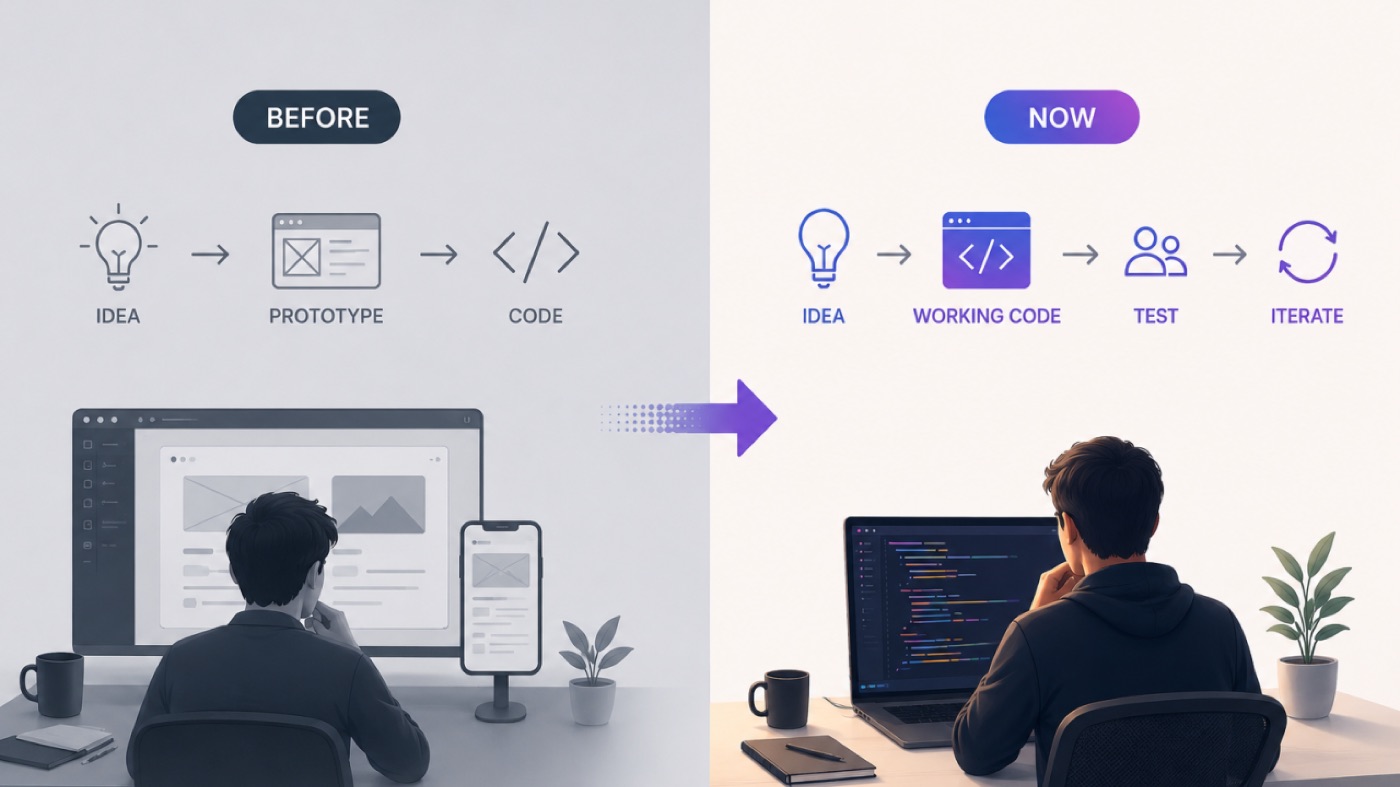
Idea → Prototype → Test → Iterate → Code
The prototype was there to reduce risk. Before spending on engineering, the team would validate the idea with users to catch usability problems as early as possible, then perhaps add a few rounds of refinement.
But AI is changing that assumption.
When AI can produce a working version in just a few hours, many teams are starting to try a new process:
Idea → Working Code → Test → Iterate
The prototype isn't disappearing so much as moving from Figma to working code itself. With AI, editing a product that already runs is sometimes faster than redoing a prototype over several rounds.
This also explains why many companies are shortening their sprints — there's even talk of a 24-hour sprint: people make the decisions during the day, and AI agents keep building overnight.
What stands out most is that this shift doesn't only affect the process; it also changes the role of the Designer.
If AI can already generate interfaces, write frontend code and build prototypes very quickly, a Designer's value will no longer lie mainly in drawing screens. It moves to understanding users, defining the right problem, building the Design System, evaluating solutions and making the decisions AI can't yet make.
That's also why ideas like Design Curation and Design Engineering come up more and more. Designers don't have to become developers, but they will need to understand how the product is built to collaborate effectively with AI and the engineering team.
The shift puts pressure on other roles too. QA has to get better at verifying complex edge cases. PMs need to focus more on direction and decision-making. BAs have to get closer to users to make sure the team is solving the right problem.
In my view, the group under the most pressure will be Designers who focus only on execution. As AI gets better at creating UI, building prototypes and turning designs into code, the advantage of "drawing fast" will keep shrinking. Designers who don't expand into product thinking, user research or systems thinking will find the coming years harder.
AI can replace repetitive work, but it's very hard to replace the ability to ask the right question, understand the context and make decisions that balance users, business and technology.
Perhaps this is the moment for every Designer to ask:
Am I creating value by drawing interfaces, or by helping the team build the right product?