
In the previous article, I argued that the biggest mistake many businesses make is not failing to hire talented people, but not understanding what kind of designer they actually need.
But to know who you need, a business first has to understand itself.
When we talk about a business, we usually think of its stage first: startup, growth or mature. It is a popular classification because it reflects the size of the organization, its resources and how mature the product is.
In my view, though, looking only at the stage is not enough. Imagine two startups, each with around twenty employees.
The first is building a brand-new product. They constantly test ideas, change the product and accept failure in the search for Product-Market Fit.
The second builds management software for businesses. What they care about is stability, scalability and the reliability of the system.
Both are startups. But they clearly won't hire the same kind of designer.
What makes the difference is not only size or stage, but competitive strategy. And in my experience, this is exactly what many businesses overlook when they hire.
Business strategy decides the role of Design. And the role of Design decides which kind of designer a business should hire.
That is why, before discussing Junior or Senior, Generalist or Specialist, we need to understand how the business competes.
Looking at a business through the Miles & Snow lens
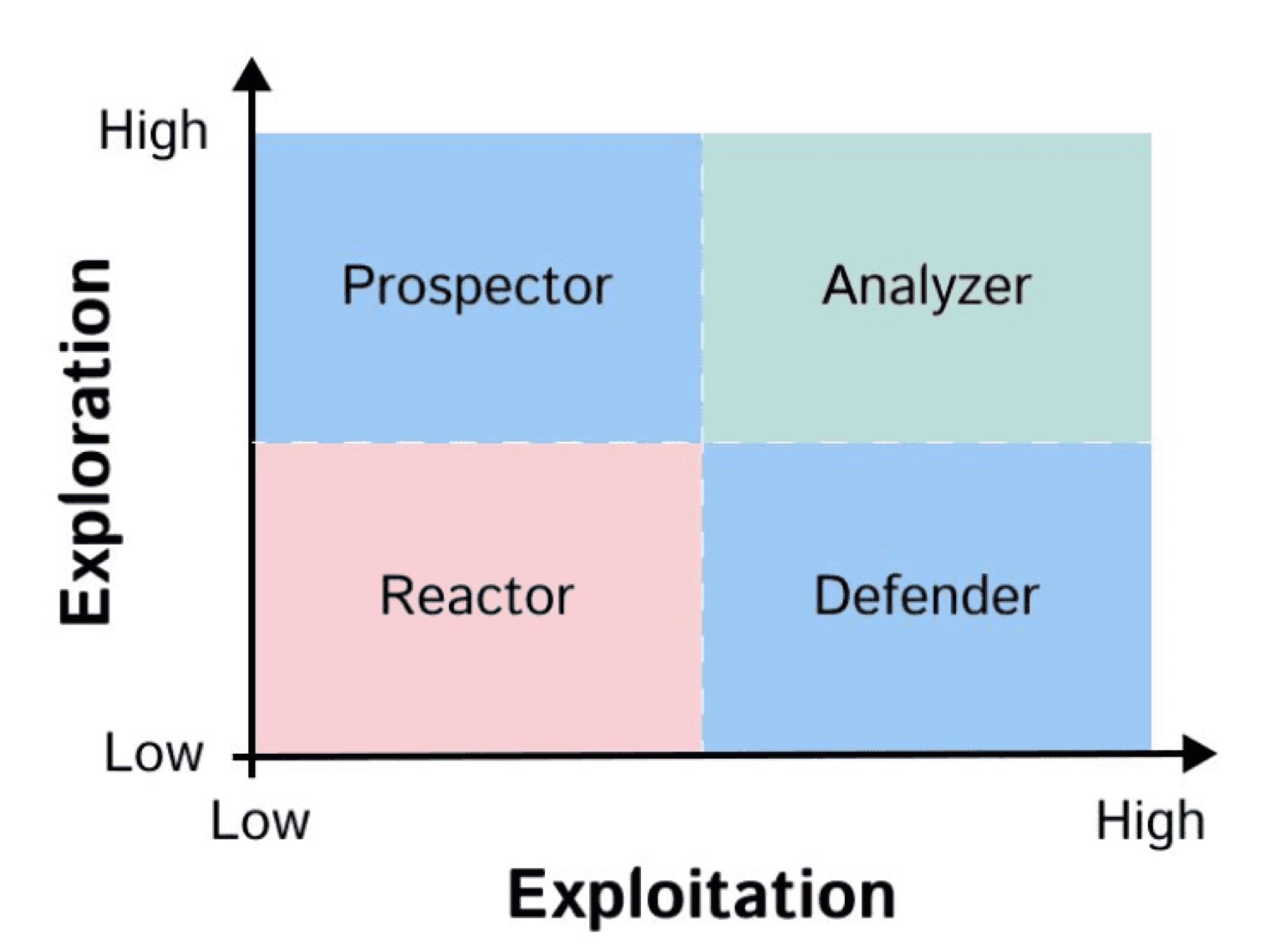
One model I find useful is Miles & Snow. It is a classic model in strategic management that describes how businesses choose their competitive path in the market.
Although it wasn't built for design, it helps me look at a business through a simple question: if businesses compete in different ways, do they need the same design team?
According to Miles & Snow, businesses tend to fall into one of four groups.
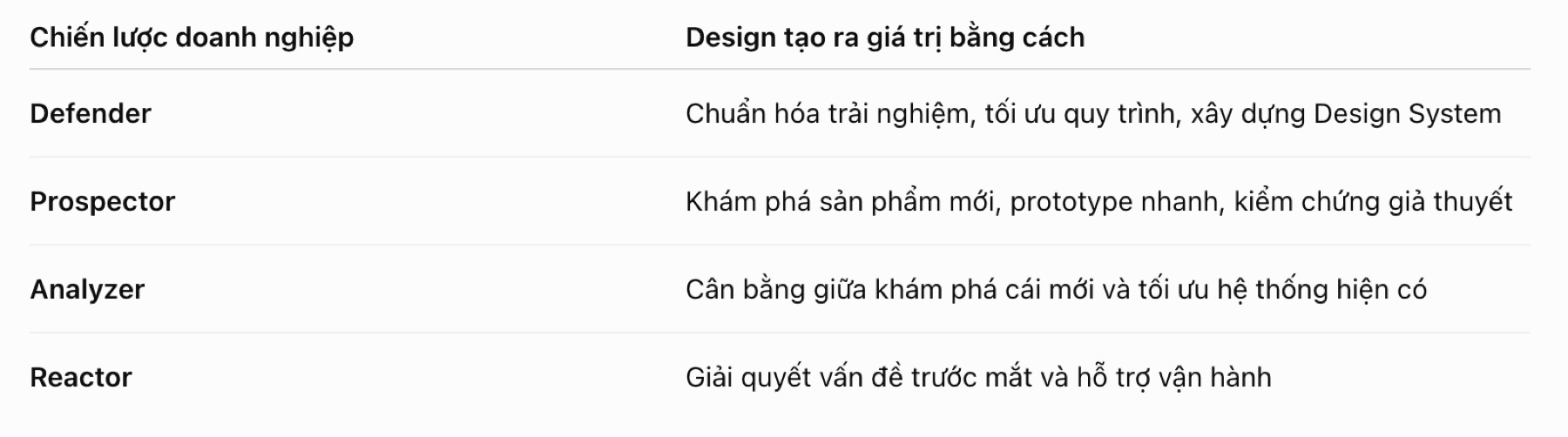
1. Defender
These businesses prioritise stability. They focus on optimising costs, standardising processes, reducing risk and improving operational efficiency.
Here, Design creates value through consistency, scalability and long-term efficiency.
Problems such as a Design System, usability improvements, standardised experiences or process optimisation usually play an important role.
2. Prospector
This group is always exploring new opportunities. They are willing to experiment, accept failure and look for new markets or product models.
In this environment, Design has to help the business discover user needs, prototype quickly and validate hypotheses.
Design doesn't only answer: "How should we design this product?"
It also takes part in the question: "Should we build this product at all?"
3. Analyzer
Analyzers sit between innovation and optimisation. They watch the market, learn from models that have proven to work and then improve on them in their own way.
So Design here has to be able to explore new opportunities while maintaining the quality and consistency of the existing system.
This is usually an environment that asks designers to balance exploration and execution.
4. Reactor
This group has no clear strategy. They tend to change only when the market or competitors force them to.
In such an environment, Design spends more time solving immediate problems than building long-term capability.
That doesn't mean the designers here are any less capable. It means the environment may not let Design deliver its full strategic value.
When strategy changes, the role of Design changes too
What I find interesting is that when hiring designers, many businesses look at the portfolio, the title or years of experience. The question that should come first is:
What value does Design need to create for the business strategy?
Get this question wrong and the business will very likely hire the wrong person, however talented the candidate is.
Another way to look at designers
After many years of hiring and building design teams, I've found that splitting designers into UI Designer, UX Designer or Product Designer doesn't help me much when hiring.
Two people with the same Product Designer title can have completely different skills, ways of thinking and experience.
What I care about more is: how does this designer create value?
So I usually look at designers through two capabilities:
- Exploration: generating new ideas, experimenting and looking for opportunities.
- Standardisation: building systems and processes and helping the product grow sustainably.
Put these two capabilities on two axes and we can picture four groups of designers.
1. Artist – Aesthetics & Exploration
Artists are usually strong in aesthetic sense, creativity and expression. They may come from Graphic Design, Fine Art, Visual Design or similar fields.
They care a lot about imagery, colour, typography, composition, motion and the emotion a product creates. These candidates didn't necessarily go to art school, but I tend to favour schools with more hand drawing, colour and composition in the curriculum.
Someone who studied engineering can still be an Artist if that is their real strength — perhaps they have practised since childhood.
Artists create the most value on problems that need strong visuals, exploration, identity and new directions.
2. Product Creator – Logic & Exploration
Product Creators connect creativity, users and business. They like to explore problems, ask questions, experiment and turn an unclear idea into a usable product. They are usually a good fit for 0 → 1 problems.
Their background can vary widely: Design, Engineering, Psychology, Business or another field. For this role I still favour schools with plenty of art subjects, but the interview starts to lean much more on logic, critical thinking and how the candidate frames problems.
What matters is not what they studied, but their ability to think and build a product when there aren't many clear answers yet.
3. Craft Designer – Aesthetics & Standardisation
These are designers with depth in a specialist area who want to make its quality really good.
They can be very strong in:
- UI
- Typography
- Motion
- Visual Design
- Accessibility
- Interaction Design
Unlike someone with an Artist leaning, they don't necessarily want to keep breaking boundaries. They may prefer the question: "How do we do this really well, really consistently and to a high standard?" This group gives the team its specialist depth.
When hiring for these roles, the interview panel must include people with matching specialist depth.
4. Systems Designer – Logic & Standardisation
Systems Designers are strong at systems thinking.
They care about:
- Design System
- Information Architecture
- Process
- Consistency
- Scalability
- Governance
They tend to enjoy questions like: "If the product gets 10 more teams, how will this system hold up?" This group usually creates the most value on 1 → 100 problems or when the organisation starts to scale.
Same as above: the interview panel must include people with matching specialist depth.
An important note: this is not about years of experience
These four groups are not Seniority Levels. A designer with ten years of experience can still be an Artist. A designer with only a few years can already have a very strong Product Creator mindset.
A Systems Designer can be Senior, but can also be a young designer growing quickly in this direction.
So when hiring, I don't think the first question should be: "How many years of experience does this candidate have?"
It should be: "What kinds of problems has this candidate solved, and how do they create value?"
From there, design the right interview questions. Avoid questions that aren't the candidate's strength and aren't what the business cares about either.
Putting the two views together
When we combine business strategy with designer archetypes, a fairly clear relationship starts to appear.
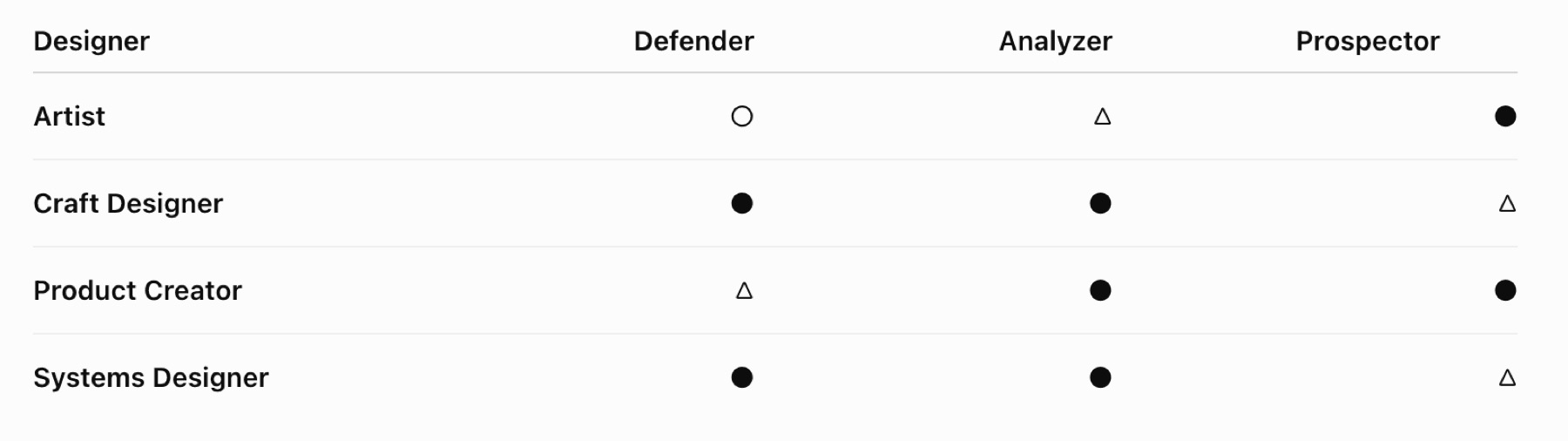
I don't see this as a hiring formula. A startup may still need a Systems Designer when it starts to scale. A large corporation may still need an Artist when it develops a new product or brand. And an Analyzer doesn't have to share a Defender's Design Team structure.
What matters is understanding: what value does the business need Design to create?
Only then decide: which kind of capability is best placed to create that value?
A perspective for designers
If you're a designer who has read this far, I'd like to share the view from the other side.
Through my work and hiring, I haven't only met businesses that hired the wrong people. I've also met many designers who chose the wrong environment to grow in.
It's a pity to see. Some are highly creative but join an organisation that mostly needs process and operational optimisation. Others have very strong systems thinking but work somewhere that changes constantly, lacks direction and offers no chance to build anything long-term.
After a while, the problem may not be the designer's ability at all, but the mismatch between person and environment. That's why I've always believed that choosing the right company matters as much as a company choosing the right designer.
At every stage of your career, take time to understand yourself:
- What kind of problems are you strongest at?
- Which capabilities do you want to grow?
- How do you want to create impact?
- Which environment lets you make the most of your strengths?
The right company doesn't just help you do your current job well.
It can also shape what kind of designer you become over the next few years.
Because fit is always a two-way relationship:
Businesses need to find the right designers. And designers need to find the right businesses.
Conclusion
After more than twenty years in design, I've realised that most businesses don't hire badly because of a lack of good candidates. They hire badly because they start from the wrong question.
Instead of asking: "Should we hire a Senior or a Junior?" perhaps a business should ask: "What value does our strategy need Design to create?"
Then move on to: "What kind of capability do we need to create that value?" And finally: "How should we build the team?"
In the next part, we'll move from the designer to the design team. How do a startup, a growing company and a mature business need different team structures?
When does a Generalist create more value than a Specialist? When should you hire a Junior, and when do you need a Senior? And how do you combine people with different capabilities into a team that can grow with the business?
That will be the subject of Part 3 – How to Build a Design Team.